Introducing Svampbase, task management for the interruption-driven day
When making the move from individual contributor to manager as a software engineer, it's natural to anticipate that the kinds of things you'll work on will change. What may be less obvious is that the rhythm of the work itself is upended: what was, in the ideal case, blocks of time thinking through the best way to implement business logic in code or pondering deep technical problems, now becomes very interrupt-driven. You can go into a day with one plan and have it quickly scrambled as a high-value customer puts in an urgent helpdesk ticket, or a project that seemingly had been smooth sailing suddenly becomes at risk of missing the next milestone deadline. In the role of engineering manager there's a real need to be able to pick up and drop threads repeatedly without losing context.
I've toyed with different solutions over the years. I've tried apps like Todoist to track tasks but found the default list view very limiting. I've heard good things about note-taking systems such as Obsidian but find the initial setup and learning curve to be too daunting. Stripped-down ticket-tracking systems like Trello come close, but still seemed lacking in specific features to really supercharge how I work.
Such a system has been on my mind for years, but getting up to speed with modern front-end development seemed like a hurdle that I'd never be able to cross. Then Claude Code came on the scene, and my dream of a better tool was within reach, enabling me to quickly iterate and improve on a tool without getting snagged on all the little footguns in the dev process.
Additionally, the Claude Code CLI has become an essential part of my daily work. In any given day I might do any or all of these:
- Generate a Snowflake SQL query to summarize payment transaction statuses for the last 90 days for a particular processor or customer
- Analyze behavior in code components to summarize their behavior as the seed of new documentation that will live in Confluence, that may span several internal repositories
- Synthesize information around a recent incident, including Slack threads, email threads, Datadog, and a Snowflake-generated report to provide a summary for upper management
These can all be short-lived projects that take an hour or two, or they may go through multiple phases of gathering stakeholder input that can span weeks, and it can be impossible to predict. My previous approach had been a "scratchpad" folder that became an all-purpose Claude Code junk drawer, accumulating dozens and dozens of files where a comprehensible filename or recently changed file-modified date was often my best hope of finding anything. It quickly became clear that this wasn't sustainable.
Additionally, I found myself living task-to-task and without opportunities for much reflection. Were there categories of work that would be better to delegate to others on my team? Were there opportunities to build out automation or self-service tooling to take things off my plate? It was hard enough to even remember what I worked on yesterday, let alone do any analysis.
With those needs in mind, I wanted to build something taking the features I liked best from what was out there already, and sprinkle in elements that would especially help in capturing context and history around the work I do.
Introducing Svampbase
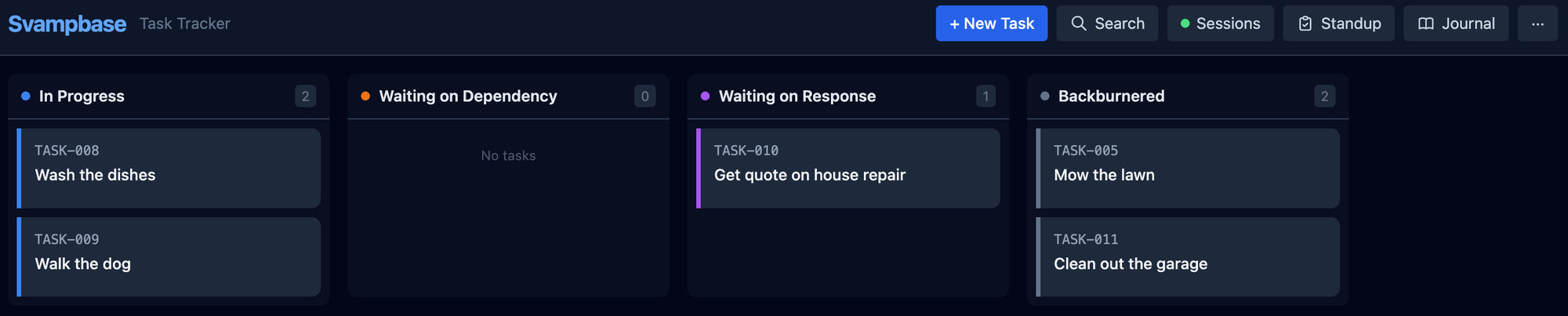
Svampbase is a web-based client app and a back-end, both written in TypeScript, using node.js for the server. There are suites of tests for both components. The code is released under the MIT license. The app is meant to run completely on your machine, and uses a flat-file as data storage. No registration, accounts, or API keys needed. The README provides easy instructions on how to get it up and running.
The name Svampbase comes from the Norwegian word for "sponge" + base, meaning a system to soak up all the context for your tasks and then allow you to squeeze it out later.
Some of the key features:
- Runs locally on macOS, Windows, and Linux
- Easy import and export of your data in a Markdown file. No lock-in!
- Tasks are represented as cards in columns by status
- You can add links within each task, as well as tags to categorize them
- For each task, you can create a Claude Code session that runs in a task-specific folder
- Tasks can be "snoozed" to remind you in 4 hours, 24 hours, etc.
- Exports a summary of what you worked on yesterday or last week
- Journaling feature to write down thoughts, wins, challenges, or anything else worth revisiting
Task tracking and context
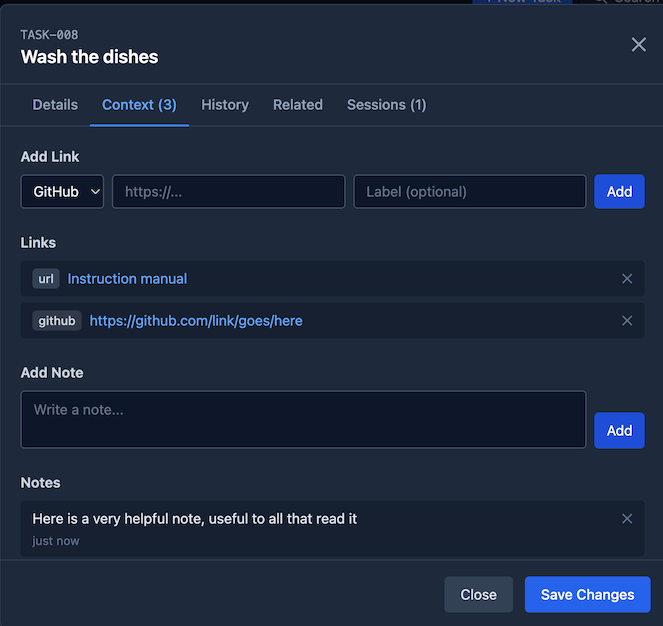
Each task card is a central place to accumulate related information. There are links to common apps such as Slack, Jira, and email, as well as a tagging feature so you mark all "customer_requests" or "documentation" tasks, to find them later or identify patterns.
Snoozing lets you free up mental space for now without the task completely disappearing, which is especially helpful if you frequently need to reach out to internal or external contacts for more information and don't always get a prompt response.
Claude Code integration
Solving the junk drawer problem, in Svampbase you can create a linked Claude session from any task. This creates a subfolder for that task, keeping any files you create neatly organized, and you can navigate to that folder from the web interface as well.
You can close the terminal window at any time to suspend the session, then come back and resume it later from the task and pick up where you left off.
Now I can avoid the overload of a folder teeming with file and swap contexts easily. Even if my filenames aren't the most descriptive, it's easy to keep task-related files grouped and avoid distracting Claude with unrelated context.
Reflection and growth
Soon after I became a manager I was able to participate in an internal leadership learning program at work, and as part of it they provided a subscription to a 1:1 coaching service with the same executive coach each week. While some participants jokingly called it "therapy for managers", for me it was an invaluable service to get feedback and input on where I'd been putting my energy, and how I might tackle looming challenges. Management can feel very lonely, and as I mourned losing my subscription to this service, I came up with two features that could partially re-create this kind of support in Svampbase.
First, I added a journaling feature, a freeform textbox that I could use to capture my thoughts as notable things came up. For example, writing down how I felt a 1:1 with one of my direct reports went after I gave some feedback on a recent project, or how I navigated backfilling a key position on my team during turbulent times.
Second, I built in the ability to export a report showing what I worked on in the last week, and journal entries made during that timespan as well. Besides the report itself, it is tremendously helpful as an input to a Claude Code session initiated with this prompt:
Analyze this file showing what I worked on in the last week. Identify patterns and ask questions one-by-one to help me find areas of growth to focus on in the next few weeks.
This has allowed me to think about topics such as where there's potential for upcoming risk on the team, where I should shift my priorities, and where I'm happy and want to lean in more.
It's not a full replacement for getting feedback from another human you trust, but it is helpful as that first pass of reflection that can highlight areas to bring up in a 1:1 with your boss or with your peers.
Going forward
I've been using Svampbase for several weeks now and have already found it extremely valuable, even in these early days. My goal is to have more folks try it out, shake out more bugs and provide more feedback on where it could go next. I know it won't work for all folks in all situations, but I hope that some find it useful and others may find it a useful code-base to fork and add features that make sense for them. With Claude Code, the time between having an idea and making it happen has been immensely shortened, so using Svampbase day-to-day and seeing what actually helps and what gets in the way is where I can provide value.
Beyond bug fixes and small tweaks, the next thing I'm working on adding is an MCP server to allow Claude Code to know more about task context and feed outputs back into svampbase, to make the two tools feel more connected.
The new world of bespoke software is an exciting and sometimes scary, and I'm looking forward to seeing what patterns and possibilities emerge.